Highlights:
- Quarterly tax equivalent net interest margin of 4.13%, expansion of 0.17% over prior quarter.
- Quarterly deposit growth of $7.3 million, despite retiring $10 million of brokered deposits.
- First quarter net income of $2.4 million; $0.33 per diluted share.
- Quarterly return on average assets of 1.18%.
- Announced the pending retirement of Ron Green, scheduled later in 2026. Amber White has been named as successor.
- Named one of the 100 Best Companies to work for in Oregon, by Oregon Business
View full release with financial tables: MAR-Statement-of-Condition-Q1-2026-WEB.pdf
Florence, Ore., April 21, 2026 – Oregon Pacific Bancorp (ORPB), the holding company of Oregon Pacific Bank, today reported net income of $2.4 million, or $0.33 per diluted share, for the quarter ended March 31, 2026, compared to $2.7 million or $0.37 per diluted share for the quarter ended December 31, 2025. “Our first quarter results demonstrate the benefit of our disciplined approach to credit and pricing, driving our sixth consecutive quarter of margin expansion,” said Ron Green, CEO. “This sustained performance positions us well as we continue to serve our local business and nonprofit clients.”
The Bank’s first quarter net interest margin increased to 4.13%, up from 3.96% reported in the fourth quarter of 2025. Despite the prime rate remaining flat during the quarter, loan originations continued to occur at a rate higher than the existing portfolio yield. This contributed to an increase in the quarterly loan yield to 5.96%, up from 5.80% in the fourth quarter of 2025. Quarterly loan production for new and renewed loans totaled $27.8 million, with a weighted average effective rate of 6.91% and a weighted average repricing life of 2.33 years. Despite robust quarterly loan production, the Bank experienced a modest decline in outstanding loan balances. This was primarily driven by approximately $16.7 million in early loan payoffs at a weighted average effective rate of 5.92%. A significant portion of these payoffs resulted from the sale of one property, while other borrowers refinanced into long-term financing through FNMA programs that offered 30‑year fixed-rate structures without personal guarantees, which represent terms that fall outside the Bank’s current risk and pricing appetite. Associated with the early payoffs, the Bank recognized $139 thousand in prepayment penalties. Additionally, amortization of deferred loan origination fees increased during the quarter to $139 thousand, up from $94 thousand during fourth quarter, as any unamortized loan origination fees are recognized as an increase to interest income upon early payoff. The impact of loan prepayments and loan fee amortization on the margin for quarters ended March 31, and December 31, were 14 bps and 5 bps, respectively, indicating approximately 9 bps of the 17 bps quarterly margin expansion during first quarter 2026 was tied to nonrecurring prepayment activity.
Period-end deposits totaled $706.7 million, reflecting quarterly growth of $7.3 million, despite the redemption of $10 million of callable brokered CDs retired during the quarter. These brokered deposits were evenly split between January 2027 and January 2029 maturity dates, and both carried a 5.0% rate. While the call option was purchased at a premium versus non-call brokered CD funding, the optionality ultimately provided the Bank the opportunity to eliminate high-cost funding in tandem with core deposit growth. The brokered CDs were retired on March 27th, thus most of the quarter over quarter benefit will not be realized until the second quarter of 2026. At current market rates, the original brokered CD maturities could be replaced at approximately 4.0%, representing reduced interest expense if it was deemed appropriate to replace the noncore funding in the future.
Classified assets on March 31, 2026, totaled $10.6 million, and reflected a decrease of $2.5 million from the fourth quarter of 2025. Classified assets are defined as loans and loan contingent liabilities internally graded substandard or worse, impaired loans, adversely classified securities and other real estate owned. The reduction in classified assets was primarily attributable to upgrades for two commercial and industrial loan relationships, totaling $2.2 million and $1 million, respectively. Partially offsetting these improvements was the downgrade of an owner-occupied nonprofit relationship totaling $1.8 million. The primary collateral is an owner-occupied building with a loan-to-value of less than 50%. Financial operations are expected to stabilize based on 2026 operating budgets with no loss anticipated for the Bank. On March 31, 2026, nonperforming loans totaled $2.1 million, representing a quarterly decrease of $246 thousand, which was directly tied to a charge off recorded during the quarter. First quarter provision for credit losses on loans totaled $37 thousand, while the provision for unfunded commitments reflected a credit of $30 thousand. The modest increase in provision was a product of essentially flat loan balances versus December 2025, in conjunction with stable asset quality metrics.
First quarter noninterest income fell to $2.1 million, reflecting a $221 thousand decrease compared to the prior quarter. The most significant change observed was a $196 thousand reduction in trust fee income primarily due to the normalization of transactional revenue. While quarter ended March 31, 2026 trust fees declined versus prior quarter, quarter ended December 31, 2025 benefitted from relative spikes due to fees from real estate transactions. As of March 31, 2026, trust AUM increased to $307.6 million, reflecting a quarterly gain of $9.9 million and an annual increase of $40.2 million or 15.1% from March 31, 2025. Trust services continue to be a valuable source of noninterest income which the Bank anticipates continuing to grow throughout 2026.
In the first quarter of 2026, noninterest expense totaled $6.8 million, reflecting an increase of $471 thousand compared to the previous quarter. The largest expense fluctuation occurred in the salaries and employee benefits category, which grew $306 thousand from the prior quarter, accounting for most of the quarterly variance. Additionally, Outside Services and Other Operating Expense grew $77 thousand and $55 thousand over prior quarter, based upon backloaded accounting fees and nonprofit sponsorship activity, respectively. Below is a summary of the quarterly salaries and benefits expense detail.
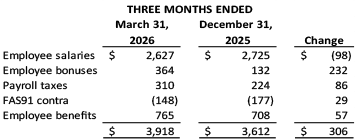
The largest quarterly increase was attributable to bonus compensation expense, which is tied to projected year end performance and is adjusted quarterly based on the forecasted achievement. The fourth quarter of 2025 saw a reduction in bonus expense largely due to a year-end true up, with quarter ended March 31 representing a normalized run rate, resulting in an increase of $232 thousand on a linked quarter basis. The Bank also experienced a quarterly increase of $86 thousand in payroll tax expense. Payroll tax counters are generally reset on a calendar basis, therefore, tax expense at the beginning of the year is typically higher and then decreases over the course of the year as employees reach wage caps. Lastly, the Bank also saw a $57 thousand increase in employee benefits expenses, primarily attributable to an increase in the Bank’s medical insurance, which increased $64 thousand over the prior quarter due to annual increases from the Bank’s medical insurance provider. Partially offsetting the above quarter over quarter increases was a $99 thousand reduction in salary expense, driven by normal turnover.
Forward-Looking Statement Safe Harbor
This release contains “forward-looking statements” within the meaning of the Private Securities Litigation Reform Act of 1995 (“PSLRA”). These statements can be identified by the fact that they do not relate strictly to historical or current facts. Forward-looking statements often use words such as “anticipates,” “targets,” “expects,” “estimates,” “intends,” “plans,” “goals,” “believes” and other similar expressions or future or conditional verbs such as “will,” “should,” “would” and “could.” The forward-looking statements made represent Oregon Pacific Bank’s current estimates, projections, expectations, plans or forecasts of its future results and revenues, including but not limited to statements about performance, loan or deposit growth, loan prepayments, investment purchases, investment yields, strategic focus, capital position, liquidity, credit quality, special asset liquidation, noninterest income, noninterest expense and credit quality trends. These statements are not guarantees of future results or performance and involve certain risks, uncertainties and assumptions that are difficult to predict and are often beyond Oregon Pacific Bank’s control. Actual outcomes and results may differ materially from those expressed in, or implied by, any of these forward-looking statements. You should not place undue reliance on any forward-looking statement and should consider all of the following uncertainties and risks. Oregon Pacific Bancorp undertakes no obligation to publicly revise or update any forward-looking statement to reflect the impact of events or circumstances that arise after the date of this release. This statement is included for the express purpose of invoking the PSLRA’s safe harbor provisions.