 When people talk about choosing a bank, the conversation often starts with interest rates and fees, which makes sense. Rates, service charges, and insured funds absolutely matter, and they should be part of any decision.
What is often overlooked, though, is that those factors rarely tell the whole story.
Over time, the value of a banking relationship shows up in quieter but more substantial ways: how easy it is to get answers, what happens when something changes, and whether you have someone who understands your business and can help you navigate complexity as you grow.
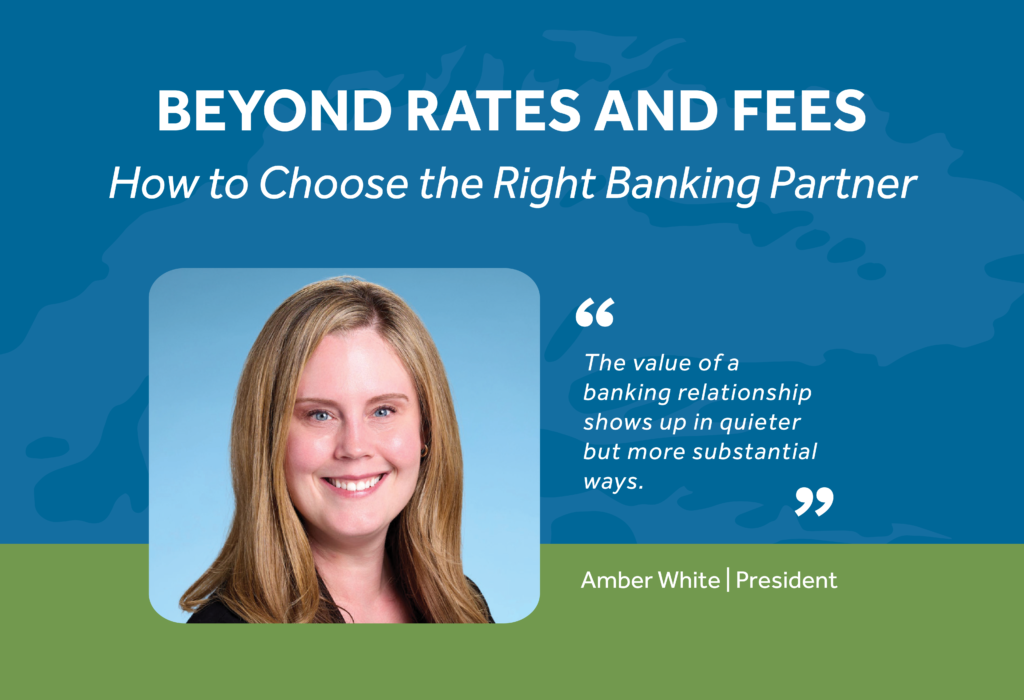
“The value of a banking relationship shows up in quieter but more substantial ways.”
If you are deciding where to bank, it’s worth stepping back and asking a broader question: what do I need from my bank beyond the dollars and cents?
From a business perspective, there are three areas that deserve more attention when evaluating a financial institution: accessibility, stewardship, and advisory support.
Choosing a bank isn’t just about rates.
It’s about partnership.
ACCESSIBILITY: How Easy Is It to Bank When You Need Help?

Accessibility is often thought of in terms of branch locations or hours, but in practice it goes much further than that.
True accessibility shows up when something needs attention; when you have a question, when a process feels unclear, or when an issue needs to be resolved quickly. It’s the difference between knowing exactly who to call and wondering where to start.
For many organizations, especially those managing multiple accounts or more complex cash flow, small moments of friction add up. Waiting on hold, navigating a call tree, or standing in line to complete routine tasks all take time. And often that translates into employee time that could be better spent elsewhere.
Accessibility also includes how a bank helps clients get started or make changes. Onboarding new accounts, setting up additional services, updating authorized signers, or adjusting access shouldn’t feel intimidating or overly disruptive. Knowing what the process looks like, and having support along the way, can make a meaningful difference.
A simple self-check can be helpful here:
- Do you know who you would call if something urgent came up?
- Do you know how your bank handles changes to account access or structure?
- Do you know where to go for help when questions arise?
These are practical considerations, but they strongly influence how smoothly banking fits into day-to-day operations.
STEWARDSHIP: What Does Your Bank Strengthen in the Community?

Another factor that is often overlooked is stewardship: how a bank is invested in the communities where its clients live and work.
Stewardship can take many different forms. It includes how deposits are used, whether lending decisions are made locally, and how involved bank leadership and employees are in local organizations, nonprofits, and community efforts.
For some clients, this matters deeply; for others, it may be secondary. Either way, it is worth considering.
Community banks play a particular role in this space. Taking deposits locally and lending them locally helps support businesses, nonprofits, and families in the same communities where those deposits originate. Over time, that creates a reinforcing cycle of local investment.
Stewardship isn’t just about philosophy, but also alignment. When a bank understands the economic realities of the communities it serves and is invested in their long-term success, that perspective often informs how relationships are managed and how decisions are made.
It may not be the deciding factor for everyone, but it should at least be part of the conversation when choosing a financial institution.
ADVISORY SUPPORT: Your Banker as a Partner, Not Just a Provider
As organizations grow, banking tends to become more complex. New services are added, transaction volume increases, and processes evolve. That’s when advisory support becomes especially important. Many clients “don’t know what they don’t know” when it comes to available banking tools. Treasury management services (such as remote deposit capture, ACH, and fraud prevention services) can significantly improve efficiency, but only if they are set up and used correctly. Without guidance, these tools can feel overwhelming or underutilized.
This is where the role of a banker as an advisor and partner really matters.

PUTTING RATES AND FEES IN CONTEXT
What are the “soft costs” of your banking relationship?
- Employee time spent resolving issues
- Delays caused by limited access
- Inefficiencies that go unaddressed
None of this is to suggest that rates and fees don’t matter. They certainly do.
Different banks have different strategies when it comes to deposit products, which influences what rates are offered and where promotions appear. Understanding that context is part of being an informed banking customer.
What is often harder to see are the “soft costs” of a banking relationship: employee time spent resolving issues, delays caused by limited access, or inefficiencies that go unaddressed because no one is proactively advising on improvements.
Looking at the full picture, both the direct costs and the indirect ones, can lead to more thoughtful decisions and better outcomes over time.
A SIMPLE FRAMEWORK FOR CHOOSING A BANK
So, when evaluating a financial institution, consider asking yourself these questions:
Rates, fees, and insured funds will always be part of the equation. But the value of a banking relationship often becomes most apparent over time: when questions arise, when circumstances change, and when guidance is needed.
Choosing a bank is not just a transactional decision. It’s a partnership choice. Taking the time to evaluate it through that lens can lead to a relationship that truly supports long-term success.