The Question Nobody’s Asking
Here’s something I ask business owners all the time, and it catches people off guard: Why are you the client of your bank?
Not how you ended up there. Not who referred you. Why are you still there?
Most of the time, the honest answer is convenience. The branch was close. The account was easy to open.
Somebody knew somebody. And for a while, that works fine. But when the rubber hits the road, when your business needs capital to grow, or the economy shifts, or you’re working through a transition, who’s going to have your back?
| That’s the question that actually matters.
The phrase “relationship banking” gets thrown around constantly in this industry, and it’s been watered down to the point where it barely means anything. Too often, it’s become shorthand for personality. Your banker knows the name of your dog. Your kids play little league together. You grab coffee once a quarter and talk about the Ducks.
That’s not relationship banking. That’s being friendly. And friendly doesn’t get your loan approved when the numbers need context. Friendly doesn’t structure a deal that actually fits how your business operates.
So, what should a banking relationship really look like?
Why So Many Businesses Feel Overlooked
If you run a manufacturing company, a construction firm, a nonprofit organization, or a professional services company, there’s a decent chance you’ve felt like you don’t quite fit your bank’s model. And you’re probably right.
Manufacturers operate within economic cycles that some banks can’t get comfortable with. Contractors face commodity price swings and elevated risk profiles that scare off lenders who don’t understand the industry. Nonprofits are structured around a mission to not profit, with no traditional ownership, which confuses banks that underwrite based on a standard template.
These are real, viable, successful businesses. But they get pushed aside because they don’t fit neatly into a box.
A Portland nonprofit our team works with (Feed the Mass, led by Jacobsen Valentine) spent weeks talking to lenders before we connected. They were financially sustainable, and doing critical work addressing food insecurity in Portland’s Old Town.
But the nonprofit model didn’t fit the traditional template, so conversations kept stalling before they could really begin. That’s not a reflection of the organization, but a reflection of the process.
And even when a business does get in the door, the experience often falls short. The same frustrations come up over and over again:
The revolving door. You finally build rapport with a banker, and six months later they’ve moved on. Now you’re starting over with someone new who doesn’t know your business, your industry, or your history. You’re re-explaining yourself from scratch.
The banker who doesn’t comprehend your financials. This one’s critical. Your banker should be able to look at your profit and loss statement (P&L) and balance sheet and have a strong understanding of what’s happening in your business, because that’s what allows them to advocate for you internally at the bank.
The acquisition shuffle. Your community bank gets acquired by a larger institution, and overnight you go from being a valued client to being a number in a portfolio. The people who knew you are gone. The decision-making moves further away.
What ties all of this together is a gap between how banks talk about serving businesses and how they actually do it. Too many layers of decision-makers. A product-focused approach instead of a solution-oriented one.
And a fundamental disconnect between what the client needs and what the banker is equipped to deliver.
It Starts with Understanding
When I sit down with a business owner or an executive director for the first time, I’m there to listen.
That first meeting should be a real conversation, not a presentation. If we’re talking about your business, your banker should be able to engage with your P&L and your balance sheet in real time, through dialogue, not by taking notes and promising to follow up later. You should walk away from that meeting with a clear sense of whether your banker actually understands how your business works.
That’s the bar. And it should be set in the first conversation.
Jacobsen Valentine, who leads Feed the Mass, put it simply after our first meeting: “The difference was immediate. He didn’t treat our project like a problem to avoid. He treated it like an idea worth understanding.” That’s what the discovery process should feel like. Not a checklist or a pitch, but a real conversation about what you’re building, and it’s your lender’s job to figure out how to help you get there.
The Questions Your Banker Should Be Asking
These are the kinds of questions that should come up in every meeting with your banker, and they’re worth expecting from anyone managing your banking relationship.
- Which method of accounting do you use, from both a tax and book perspective?
This matters more than most people realize. It shapes how a lender reads everything that follows. - Walk me through your P&L, top to bottom.
What are your gross profit margins? What do your operating expenses look like? How has profitability trended year over year? Are profits being retained in the business, or distributed out? - Now the balance sheet.
Is the company well capitalized? Do you have sufficient working capital? How has debt been leveraged, and is it structured in a way that supports how the business actually operates? - Talk to me about your cash conversion cycle.
From the moment you deliver a service or a product to the moment you collect payment, what does that timeline look like? What terms do you offer your customers? What terms have you leveraged from your vendors?
These aren’t trick questions. They’re foundational. And a banker who understands the answers can match you with the right solution, structured the right way, on the first pass.
It starts with understanding.
Understanding leads to solutions.
From Understanding to Solution
Once the discovery process is done, the conversation shifts from questions to action. And this is where the approach really matters. This isn’t about pulling products off a shelf. Every recommendation ties directly back to what the discovery process revealed.
Generally, the solutions fall into four categories:
| WHAT YOU NEED | WHAT THAT LOOKS LIKE |
|---|---|
|
Day-to-day operational financing |
An operating line of credit structured around your cash cycle |
|
Growth, expansion, or asset acquisition |
Equipment financing matched to the useful life of the asset |
|
Real estate acquisition or expansion |
A commercial real estate or construction loan |
|
Business acquisition, transition, or succession planning |
A customized commercial loan arrangement
|
These aren’t four products on a menu. They’re four categories of need, and the structure within each one changes based on the business. A line of credit for a manufacturer looks different than one for a professional services firm, because the cash conversion cycles are completely different.
Once the right solution takes shape, it goes directly to our decision-makers, our credit officers and executives, to get buy-in. And then you get a term sheet. Not a letter of intent or a letter of interest. There’s a difference. A term sheet is a commitment. It’s meant to inform you that we mean business and we’ll deliver on our word.
That distinction matters. If you’ve been handed LOIs that never turned into anything, you know exactly what I’m talking about.
Where This Approach Comes From
I learned this working alongside experienced bankers who came through formal credit training programs.
That’s a multi-disciplined approach that combines foundational credit and financial analysis with a real
customer-centric mindset. Not just the numbers or just the relationship, but both, together.

When a banker has the ability to connect with a client and the ability to understand their financials, that’s the recipe for success. One without the other doesn’t work. A banker who’s great with people but can’t read a balance sheet can’t advocate for you. A banker who’s technically sharp but can’t have a real conversation with you will miss the context that makes the numbers make sense.
That’s the approach I’m building in Portland, and it’s the approach Oregon Pacific Bank is committed to across every market we serve.
Three Things Every Business Owner Should Do
If anything in this article resonated, here’s where to start:
- Interview your banker. Sit down and have a real conversation. Make sure they understand your company: what you do, how you perform, where you’re headed. If they can engage at that level, that’s a great sign you’re in the right place.
- Know your bank. Is your bank dedicated to your industry? Do you understand the financial health and stability of the institution holding your deposits and backing your credit? This matters more than most people think about.
- Test the conversation. Here’s a simple gut check: Can your banker sit down for a full lunch and have a real business conversation, not just small talk? If the conversation keeps going, about your industry, your margins, your challenges, that’s the kind of relationship worth investing in.
Your banker who understands you, and your bank that is in sound financial condition, those will be your best friends when you need your bank. Not when things are easy. When things are hard. That’s when it counts. And it starts with a simple question: Do you know your banker?
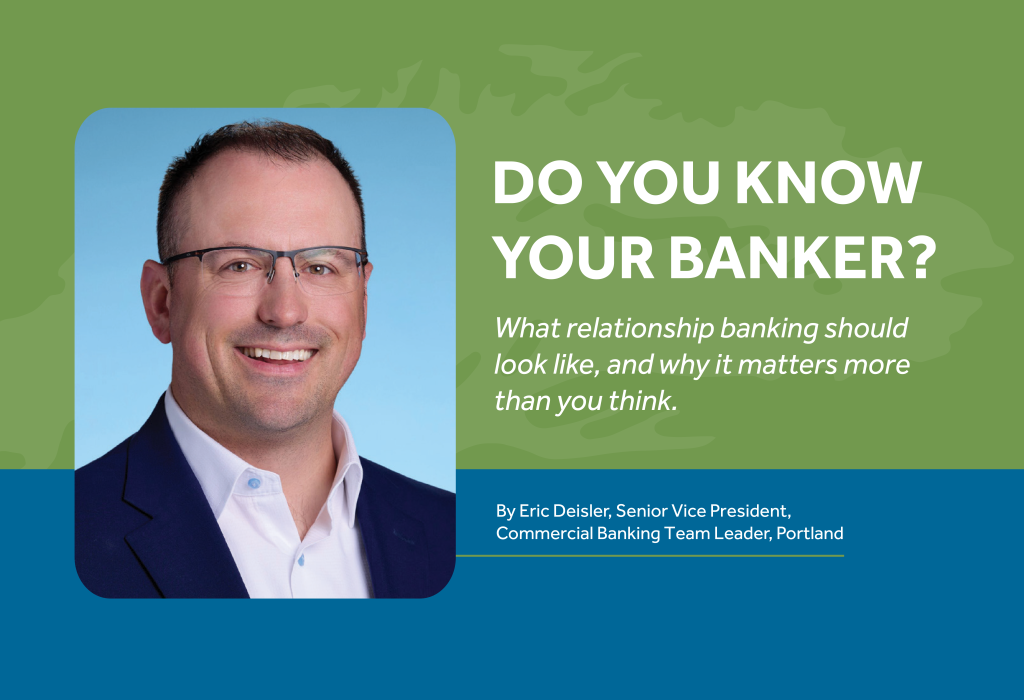
Eric Deisler leads Oregon Pacific Bank’s commercial banking team in Portland.
Let’s Talk About What Matters Most to You
CONNECT WITH ERIC:
About the Author

Eric Deisler
Eric Deisler joined Oregon Pacific Bank to help launch its Portland office, bringing over 15 years of banking experience and a strong understanding of the local business community. As Senior Vice President, Eric works with businesses of all sizes, offering customized lending solutions and leveraging OPB’s local decision-making to meet clients’ unique needs.