I went to law school after a few years in corporate finance, and I chose trust work for one reason: it let me use both sides of my background while actually working with families instead of other businesses. That combination is what drew me in, and it’s what has kept me here.
I mention it because it points to something people tend to misunderstand about the job. When most folks hear “corporate trustee,” they picture something formal and far away, a company in a tower somewhere managing money. The reality is a lot more human than that, and a lot closer to home.
Here’s what I wish more people knew: most people think about naming a trustee last, almost as an afterthought. The reasoning usually goes, “I don’t have a friend or family member who could handle this, so maybe I should look at a corporate trustee.” I’d flip that completely. Default to a corporate trustee first. For certain circumstances you might go a different direction, but that’s where you start.
Let me give you the example I come back to most, because it can happen to anyone. Mom and Dad have multiple kids. Dad passes, then Mom, and one of the children is left in charge of settling the estate. It sounds straightforward. It almost never is.
Almost without exception, the old family dynamics come right back to the surface. “You should have listed the house sooner.” “Dad always liked you better.” “How do I know you’re not siphoning money?” It’s all there in the statements, every distribution documented, but paperwork rarely settles anything once feelings are involved. And none of it takes wealth. It just takes a family.
What a trustee actually carries
Every trust needs a trustee, and it isn’t an honorary title. A trustee has a fiduciary duty, a legally enforceable responsibility to manage the trust’s assets in the best interest of everyone involved.
“Everyone” covers a lot of ground. You’re balancing the current beneficiaries, the future beneficiaries, and the intentions of the person who created the trust in the first place. Those interests pull against each other, usually the present against the future. Somebody has to weigh them, make the call, and then explain that call to every side. That is a heavy thing to hand a person who is also grieving, and who still has to live inside this family long after the paperwork is done.
The case for an outsider
This is why naming a relative gets complicated. People assume a family member will understand the situation best, and sometimes that’s true. But that same history can create bias, or put real strain on a relationship, right when the hardest decisions come due.
A neutral third party comes at it differently. No allegiances, no baggage, just the question of what is genuinely in the best interest of everyone the trust is meant to serve. As I like to put it, the trust officer isn’t the one sitting at the Thanksgiving table.
If you’re weighing a family member against a corporate trustee, sit with one question: if this trust ever came down to a genuinely difficult, controversial decision, how would you feel about putting this person in that seat and asking them to make the call? For a lot of people, that question answers itself.
What sets a corporate trustee apart
When I boil it down for someone, a corporate trustee offers three things an individual usually can’t match.
The first is impartiality, which we’ve covered. A neutral party can make and deliver hard decisions without being pulled by loyalty or family history.
The second is experience. We do this all day, every day. I once worked alongside a trust officer I called my master mechanic. I used to say you could blindfold her and she’d take the whole thing apart and put it back together without ever looking, because she simply knew how every piece worked. That is the kind of fluency with the tax law, the obligations, and the pitfalls that you can’t hand a well-meaning relative overnight. And behind any one officer sits a whole team, plus investment, accounting, tax, and legal resources, and the judgment to know when to bring them in.
The third is continuity. Any one person’s ability, interest, or lifespan can cut their service short. A corporate trustee is, more or less, always there. The people in the chair may change over the years, but the records, the processes, and the reporting carry on without a gap.
There’s one more piece worth naming: accountability. We’re regulated, which means someone is there to hold us to the standard. And the level of reporting, on distributions, taxes, and investments, runs higher, because the beneficiaries aren’t the only ones watching. The IRS has a stake in every trust too.
The part people don’t expect
For all that talk of neutrality, the actual work is personal, sometimes surprisingly so. I sometimes describe a trust officer as part financial professional, part social worker. Some of it is exactly what you’d picture, and plenty of it isn’t.
Early in my career I drove a client to a cataract surgery appointment because she had no one else to take her, and we stopped at the farmers market on the way home. That’s the strange balance of this work. I’m the impartial party, and at the same time I often end up something close to family, a steady point for people in the middle of the hardest stretch of their lives. When you’ve lost the person you built your life with, that steady hand is worth more than anything on a balance sheet.
Why a community bank is different
Not every corporate trustee is the same, and this is where a community bank genuinely stands apart. At a large national bank, the rules about which trusts to accept, and how to handle them, are often set by someone in another state who will never meet you. I spent years in that world. You end up applying a decision made in another state or across the country to a family in Eugene.
We do it the other way around. Oregon Pacific Bank keeps a trust presence in the markets we serve, so there is someone in your own town to sit down with, and the decisions and the administration happen right here. Our thresholds are lower, too. The big banks tend to price themselves out of smaller communities, but you don’t have to be a multimillionaire to need this kind of care, or to deserve it. A community bank is simply more willing to invest in trust work at the local level, and in this business that willingness makes all the difference.
Begin with the trustee
So here’s my advice. Don’t begin with, “I don’t have anyone who can do this, so I suppose I’ll consider a corporate trustee.” Begin the other way around. Consider a corporate trustee first, and step away from it only if your circumstances clearly point somewhere else.
What you’re really choosing isn’t a company or a fee schedule. It’s peace of mind, the confidence that whoever you leave behind won’t be left to carry it alone.
To talk with a local trust officer in your community, reach out to Oregon Pacific Bank’s Trust Services team.
About the Author

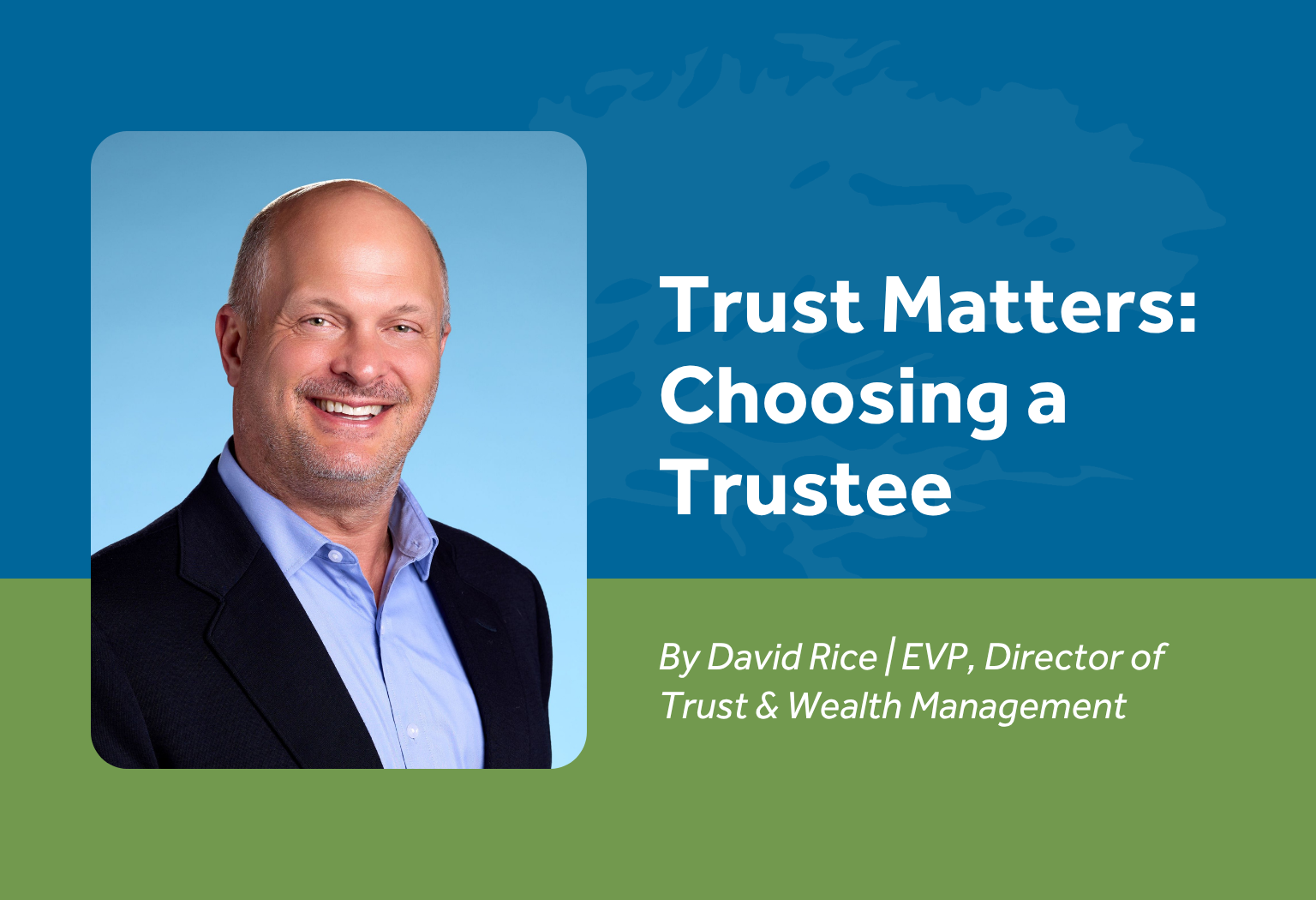
David Rice
David Rice leads Trust & Wealth Management at Oregon Pacific Bank, bringing two decades of fiduciary leadership and client service to families, businesses, and nonprofits across Oregon. Known for translating complex financial matters into clear, coherent plans, David focuses on long-term stewardship, fiduciary responsibility, and relationships that stand the test of time.