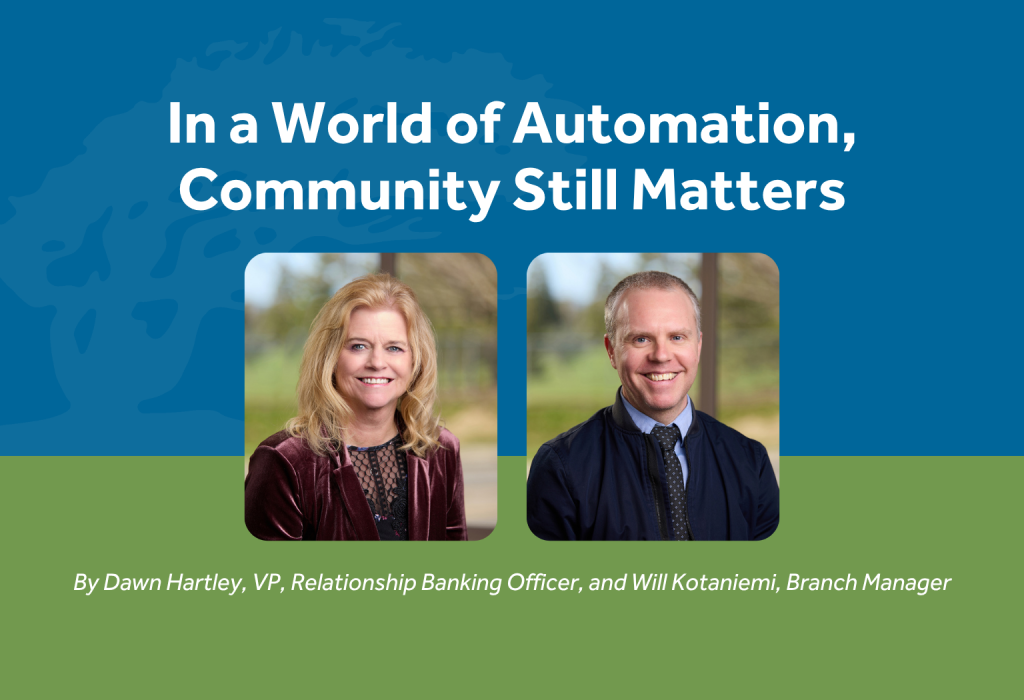
Technology should enhance the customer experience, not replace the human connection behind it.
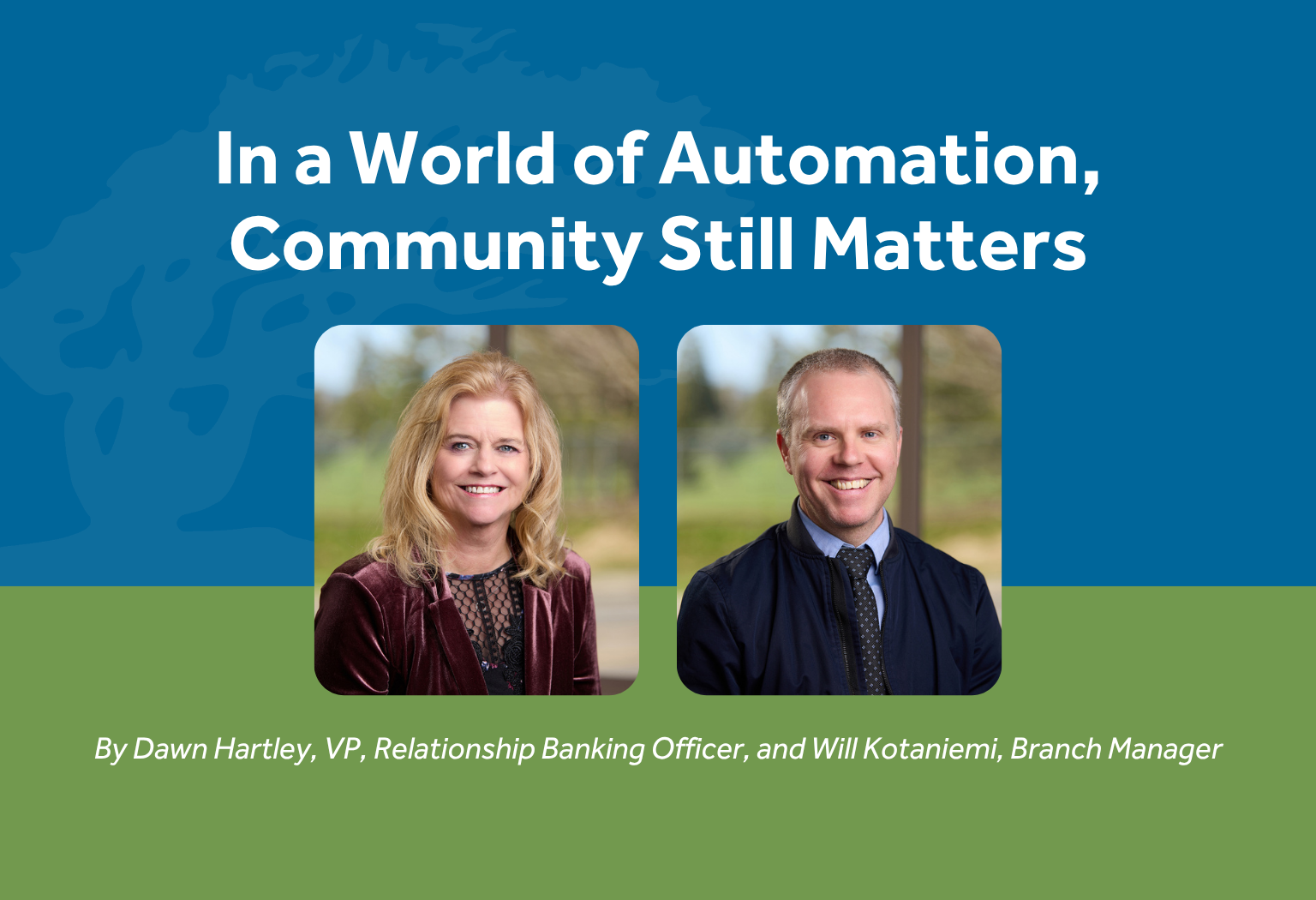
By Dawn Hartley, VP, Relationship Banking Officer, and Will Kotaniemi, Branch Manager
Banking has changed dramatically over the last decade.
Mobile banking, online account access, remote deposit capture, digital document signing, and other innovations have made banking more convenient than ever before. Those tools matter, especially to business owners whose time is already stretched thin.
For most people, that’s a positive change. Routine banking tasks that once required a trip to a branch can now be completed from virtually anywhere. Yet as banking has become more digital, many customers have discovered that some needs still call for a conversation.
“The number one thing we hear is, ‘Oh my gosh, you guys answer your phone!’ That’s huge,” says Dawn Hartley, Vice President and Relationship Banking Officer in Medford.
It usually gets a laugh. But behind the humor is a frustration many consumers and business owners know too well.
Most people aren’t calling their bank because everything is going smoothly. They’re calling because they have a question, need help solving a problem, or are dealing with a situation that doesn’t fit neatly into an online form.
A card stopped working. A transaction doesn’t look right. A payment didn’t arrive where it was supposed to go. Something happened, and they need help understanding what comes next.
In those moments, technology alone isn’t always enough.
People want someone who can understand the situation, answer questions, and help them work toward a solution.
The challenge isn’t technology itself, but making sure convenience doesn’t come at the expense of connection.
Someone Has to Own the Problem
Will Kotaniemi, Medford Branch Manager, tends to approach banking from a practical perspective. When clients call with a problem, they don’t want to explain the same situation three times to three different people. They want somebody to own it and help them fix it.
“When they have an issue with their banking and they call us, we take care of the problem here in-house,” he says. “We don’t give them a phone number to call another department, which then gives them a phone number to call another department, and then they get stuck in some weird loop.”
There are limits to what any banker can do, of course, but Kotaniemi’s instinct is to complete as much of the work as possible before asking the customer to take the next step.
“I can’t call the IRS for someone,” he says, “but I can do all the legwork for them, so all they have to do is just make the call.”
That willingness to see a problem through is part of what distinguishes a relationship from a transaction. The customer isn’t handed off and expected to start over. The banker stays involved.
For Kotaniemi, it begins with something even simpler: knowing who you’re talking to.
“People are people. They’re our customers. We know about them. We know about their families,” he says.
“We take the time to know them, not just to sell them products.”
Bank clients know their Medford team, too. They recognize the people answering the phone and working in the branch. That familiarity means they aren’t rebuilding the relationship each time they need assistance.
They’re speaking with someone who already understands the context.
The same principle applies outside the branch.
Hartley recently spoke with a business owner who had worked with another bank for years. During the conversation, the client mentioned that no one from his bank had come to see him in at least a couple of years.
“We care, and we want to know what’s going on in their business,” Hartley says. “We don’t just sign them up, bank them, and ignore them.”
Community Looks Different Here
The relationships Hartley and Kotaniemi describe are closely connected to the community they serve.
Hartley grew up in Southern Oregon and has watched the region evolve. Through local events, business visits, nonprofit involvement, and community organizations, she has seen firsthand how interconnected the Rogue Valley can be.
People notice which organizations participate. They notice who volunteers, who sponsors local events, and who continues to show up. And they remember.
“They remember who’s involved and who’s supported locally,” Hartley says. “They’ll go, ‘Oh yeah, I know that person because they did this, this, and this.’”
That visibility creates accountability. Community involvement isn’t something that happens only through a donation or a logo placed on an event banner. It happens when people consistently show up.
Hartley often hears from clients who appreciate seeing Oregon Pacific Bank employees volunteering, attending events, serving on committees, and supporting local organizations.
“They know that we’re not just bankers sitting in our office saying, ‘Come see us,’” she explains. “They like to see us out in the community, being involved and actively supporting our local area.”
Kotaniemi noticed that same sense of connection when he moved to Southern Oregon several years ago.
“What I have noticed that’s very unique about this area is everyone’s willingness to support each other,” he says. Part of what stands out to him is the way local businesses, nonprofits, civic organizations, and residents work together. In a region that can sometimes feel removed from Oregon’s larger population centers, those connections help create a strong sense of local identity.
“Jackson County has found a very unique way to support itself, to support its communities, to support its nonprofits, and to support all of its citizens,” he says.
The Rogue Valley continues to evolve. Industries that once shaped the local economy have changed, while new opportunities continue to emerge. Hartley sees growth in services supporting the area’s growing senior population. Kotaniemi points to technology, tourism, and efforts to create opportunities for younger generations to build careers and businesses locally.
Through those changes, one thing has remained remarkably consistent: people still value relationships. In a community where people remember who shows up, that continues to matter.
And for Hartley and Kotaniemi, that’s why relationship banking still resonates. It’s not simply a banking philosophy. In many ways, it’s a reflection of the community itself.
Technology Should Support Relationships
Most people like convenience. They like mobile banking. They like remote deposits. They like being able to handle routine banking tasks whenever it fits their schedule. Sometimes they don’t want to talk to a banker at all, and they shouldn’t have to.
Neither Hartley nor Kotaniemi is arguing against technology.
They use it every day, as do their clients. Banks today use digital tools to streamline transactions, improve security, automate routine processes, and provide faster access to information.
The question isn’t whether technology belongs in banking. The question is what happens when a routine transaction stops being routine.
“We’ve all been there,” Kotaniemi says. “You think, ‘I’ll take care of this online real quick,’ and then something goes wrong. Suddenly, you need to talk to a person.”
That moment matters. It’s also where real relationships become valuable.
Banking technology continues to evolve rapidly, with artificial intelligence and automation receiving significant attention throughout the industry. Yet Hartley says that’s rarely what she hears from local business owners.
“Most of the conversations I have in the community come back to connection,” she says. “People aren’t even talking about AI.”
What they are talking about is how difficult it can be to reach someone. They’re looking for a contact who understands their business, and somebody who follows up. They want confidence that when something goes wrong, someone will answer the phone.
Technology can absolutely support those relationships, and in many cases it already does.
Digital banking tools reduce paperwork. Electronic signatures make processes faster. Remote banking services allow business owners to spend less time driving to a branch and more time running their business.
In fact, technology often creates more opportunities for meaningful conversations because less time is spent handling routine tasks.
Kotaniemi sees that with owner-operated businesses and family businesses transitioning from one generation to the next. One local business owner he works with is gradually introducing newer technology as he takes over operations from his father. The bank’s role isn’t to force change. It’s to help the customer adopt tools that make sense for the business and the way they work.
That’s technology enhancing a relationship, not replacing it.
“We want people to know community banks are up to date with technology and security,” Kotaniemi says. “We just prefer the personal touch and being the one to help you solve your problems.”
Banking will continue to evolve. The tools customers use five years from now will almost certainly look different from the tools they use today.
What Hartley and Kotaniemi hope doesn’t change is what customers value when they need help: a familiar voice answering the phone, a banker who understands their business, and someone willing to take ownership of a problem and see it through.
In communities like the Rogue Valley, those relationships still matter.
Let’s Talk About What Matters Most to You
CONNECT WITH A LOCAL BANKER
About the Author
Dawn Hartley
Born and raised in Jackson County, Dawn Hartley has more than 20 years of banking experience and joined Oregon Pacific Bank to help launch its Medford branch. She serves on the board of Southern Oregon Humane Society and the Family Service Committee for Rogue Valley Habitat for Humanity.

Will Kotaniemi
Will Kotaniemi brings more than 20 years of customer service experience to Oregon Pacific Bank. After moving from a larger bank, he values the personal connections and community focus of community banking, and he is especially enthusiastic about local initiatives that support children.