On just about any day, one of our tellers will pull me aside from the floor. “Can you come talk to this client? Something feels off.” By now I trust that instinct, because when a teller feels that way, it turns out to be fraud far more often than not.
We catch a lot of it, but we can’t catch all of it. Not long ago, a client of ours lost over $20,000, and by the time we pieced together what had happened, the money was already gone.
Financial exploitation of older adults is one of the most common, and most under-reported, crimes we see. It doesn’t require a big city or a big bank account. It just requires someone who is trusting, and sometimes a little lonely.
What we mean by elder financial exploitation
When we talk about elder financial exploitation, we’re really talking about two different threats.
The first is the outside scammer, frequently overseas, who doesn’t care how old you are, only that you’ll send money. This is the kind you hear about in the news: the urgent phone call claiming to be the IRS, the email saying a grandchild is in trouble, the pop-up warning that your computer’s been hacked. It’s a stranger creating panic and counting on you to act before you think.
The second is closer to home: someone taking advantage of a person they’re supposed to be helping. That can be a caregiver, and sometimes, sadly, a family member. One of the clearest warning signs of this kind is when a client comes in with someone who does all the talking. “She needs two thousand dollars. Or, he wants to do this.” That’s when I step in, take my client aside, and ask them directly. Too often, they aren’t even sure why they’re there.
The red flags we watch for
Because our tellers know our clients by name, we notice when something is out of character. A few patterns come up again and again:
- Transactions that don’t fit the person. When an 85-year-old who never carries cash suddenly wants $10,000, that’s a reason to gently ask questions.
- A companion who is controlling or pushy, especially one speaking for the client.
- Hesitation or a story that doesn’t add up, like money headed to a celebrity or an online friend.
The scams we see most
The sweetheart scam. A client has been “dating” someone for six months but has never met them in person. It starts with a couple hundred dollars, then a thousand, then a thousand more. After ten months, it’s several thousand gone.
The impersonation scam. We’ve had clients convinced they were sending money to Elon Musk, or, in one case, to the actor Kevin Costner for his new movie. I can’t stress this enough: Microsoft will never contact you, and a celebrity will never email you asking for money.
The tech support scam. A pop-up claims your computer has been hacked. “Click here and we’ll help.” That click can hand a stranger control of your machine and your accounts.
Simple safeguards that make a difference
We can’t tell anyone how to spend their own money, and we don’t try to. What we can do is offer safer ways to manage it:
- Add a trusted second person to the account. A family member or trusted contact can help keep an eye on things, and gives us someone to call if we’re worried.
- Lean on a debit card rather than sharing account details. If fraud hits a card, we can block it quickly. Closing an entire account is far messier, especially when Social Security is deposited there.
- Consider whether trust services are a fit. For clients without someone to lean on, a professional trustee can be a real source of protection and peace of mind.
If you think you or a loved one have already been scammed or victimized by fraud, come talk to us right away. We’ll ask how it started and what information was shared, and if a computer was involved, we’ll shut down online access until it’s been cleared by an IT professional. Acting fast is everything.
Why isolation is the scammer's best tool
Two things make elder financial exploitation thrive: loneliness and shame.
Scammers know that a lonely person who suddenly has a “friend” won’t want to let that friend go, even as the requests for money pile up. And afterward, victims often stay silent. “I feel stupid that I fell for it,” one person told me. So they tell no one, and it happens again.
I think about this more than I probably should. My own mom is 87. I hope that when I get there, someone is looking out for me the way we try to look out for our clients.
That’s why the most powerful protection isn’t a product. It’s a phone call. Check on your parents, your grandparents, your neighbor from church. Ask how they’re doing. Ask if anything strange has come up lately. And make it clear there’s no shame in it. The people who report a suspicious neighbor or a worried “something feels off” are often the reason we catch things in time.
Why a community bank matters here
We know roughly 99 percent of our clients the moment they walk in. That relationship is what triggers the red flag when a familiar face is suddenly acting differently or shows up with someone new. A large national bank usually finds out only after the customer calls to say money is already gone. We have the advantage of catching it before that.
That’s also why our Florence team visits local senior living communities regularly to help with everyday banking and to talk openly about scams. Every time we present, someone raises a hand and says, “Actually, that happened to me last week.” Those conversations save people real money.
The takeaway
Fraud isn’t going away, and with new technology it’s only getting more convincing. But awareness genuinely works. Know the red flags, build a trusted circle around the people you love, and never let embarrassment keep a problem in the dark.
If you’re worried about your own accounts or someone you care about, talk to your local Oregon Pacific Bank team. We’re here, we know you, and we’re looking out for you.
Talk to your local Oregon Pacific Bank team
About the Author

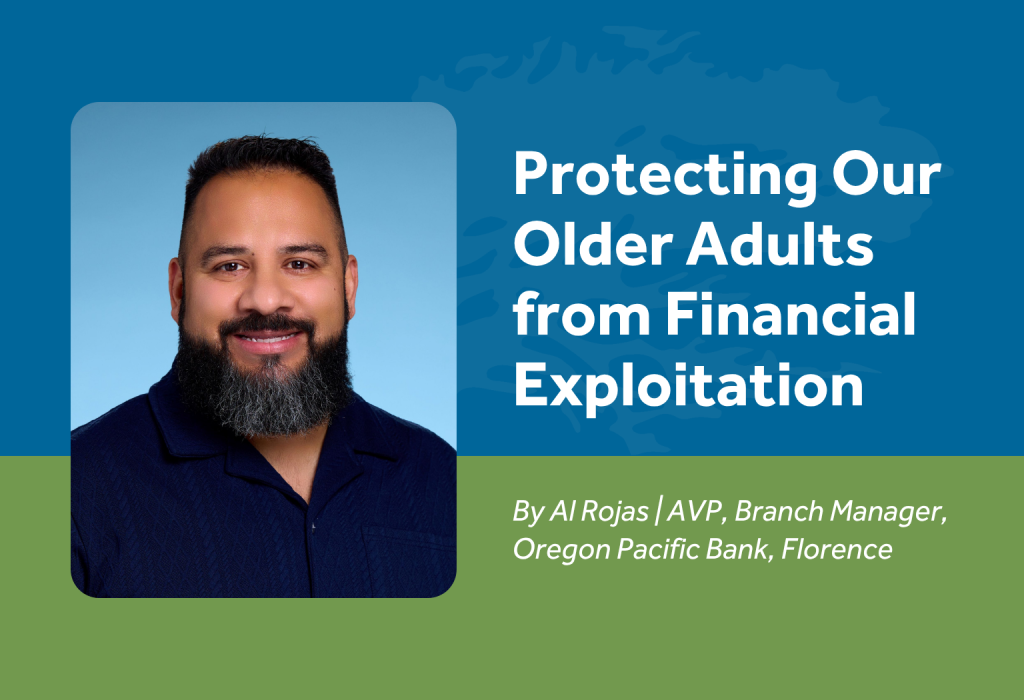
Al Rojas
Al Rojas moved to Florence from Phoenix, Arizona, drawn by the area’s friendly community, scenic beauty, and small-town charm. Starting as a receptionist at Oregon Pacific Bank, Al worked his way up to become the Florence Branch Manager, overseeing branch operations and ensuring exceptional service for customers.